
Trust in Transformation: Understanding the Dynamics
Updated: Jul 6
The Erosion of Trust in Transformation Teams
The first thing most transformation leaders get wrong about team trust is treating it as something that either exists or does not. A team either trusts each other or it does not. The work is to build it, and once it is there, it is there. This is not how trust works under sustained pressure. Trust in transformation teams is dynamic. It rises and falls based on what the environment is asking of people.
In the early phase of a transformation, the environment tends to be trust-positive. Roles are still being defined, everyone is slightly uncertain, and the social norm is to collaborate because no one can afford to go alone. Early in a program, people share information freely, ask for help without embarrassment, and extend goodwill to colleagues they barely know. The stakes feel high, but the personal exposure feels manageable.
What changes halfway through is that the stakes have become personal. People now have visible track records. They have delivered or not delivered. They have made calls that turned out to be wrong. The program has survived long enough for there to be winners and losers in the internal competition for credit, resources, and executive attention. Trust erodes not because people have changed but because the context has changed what trusting someone costs.
The Specific Mechanisms That Break Trust
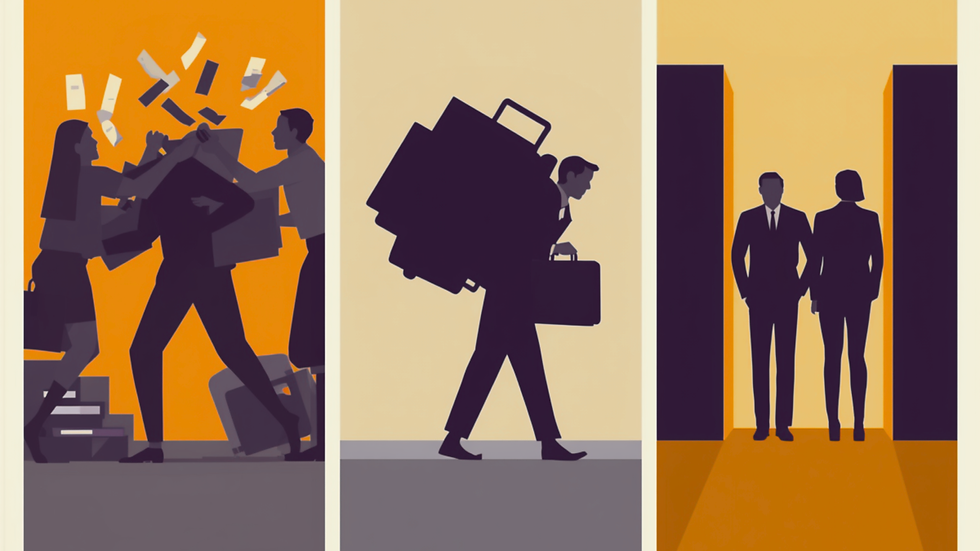
Research from Harvard Business School on team dynamics in high-pressure projects found that trust deterioration in project teams follows a recognizable sequence rather than a sudden collapse (Harvard Business Review, "The Secrets of Great Teamwork," 2016). Understanding the sequence matters because the intervention depends on where a team currently sits in it.
The first mechanism is information asymmetry. In the middle phase of a transformation, certain team members become gatekeepers to information that others need. This is often unintentional, a consequence of role specialization, but it creates a structural inequality that trust cannot survive. When one person knows things another person needs, and the sharing of that information is not mandatory, the receiver has to trust that the giver will share it anyway. Some people will, and some will not, and the team quickly learns that the information they receive may not be complete. At that point, meetings stop being collaborative and start being performances.
The second mechanism is misaligned accountability. Transformation programs almost always start with collective ownership of outcomes and gradually drift toward individual accountability as pressure mounts. Senior stakeholders, uncomfortable with ambiguity, start asking who specifically is responsible for each workstream. Program leaders, anxious to demonstrate control, start tracking individual performance more closely. The team receives this signal clearly: we are no longer in this together. When accountability individualizes, the rational response is to protect your own performance, which means being careful about what you share, what you own, and whose problems you step in to solve.
The third mechanism is unaddressed conflict. Transformation teams produce conflict constantly, and most leaders are not equipped to address it in real time. By the midpoint of a program, there are almost always two or three unresolved interpersonal disputes sitting below the surface of every team meeting. These disputes do not dissolve. They harden. Patrick Lencioni's research on team dysfunction identifies unaddressed conflict as the single most reliable predictor of trust breakdown, specifically because teams that cannot have honest conflict start using silence as a strategy, and silence compounds every other problem (Lencioni, "The Five Dysfunctions of a Team," 2002).
What the Leader Can See If They Know Where to Look

The signals of trust deterioration are visible before they become critical. The problem is that most transformation leaders are not looking for them because they are focused on program delivery.
Watch the meeting behavior. When a transformation team is trusting, meetings are messy. People interrupt each other, challenge assumptions, and openly admit when they do not know something. When trust is eroding, meetings become clean and quiet. Everyone says what they are supposed to say and saves the real conversation for afterwards. If your program update meetings are running smoothly and everyone is aligned, that is not necessarily good news. It may mean that your team has decided that honesty in the room is no longer safe.
Watch the information flow. Pay attention to how easily information moves across workstream boundaries. If you are regularly hearing "I did not know that" from people who should have known it, the information-sharing norms have broken down. In trusting teams, over-communication is the norm. In distrustful ones, people share what they have to and hold everything else.
Watch who is not speaking to whom. By the midpoint of most transformation programs, there are one or two relationships on the team that have quietly become adversarial. These are almost never acknowledged directly, but they affect everything: who gets invited to which conversations, whose input gets credited, and whose mistakes get highlighted. If you can identify these relationships early, you can intervene before they become structural.
What to Do About It
The instinct of most leaders when they recognize a trust problem is to address it at the interpersonal level: one-on-one conversations, team-building activities, or a facilitator brought in to run a workshop. These interventions can be valuable, but they are not sufficient if the structural conditions driving the distrust remain in place.
The first structural change is to restore collective accountability in at least one high-visibility area. Pick a workstream outcome that currently sits with one person and explicitly share accountability for it across the team. This sends a signal that the program's success is still a collective endeavor, and it creates the conditions for genuine collaboration rather than parallel working.
The second is to create mandatory information-sharing rituals that do not depend on individual goodwill. Weekly cross-functional updates where each workstream lead is required to share one thing they have learned that the rest of the team needs to know. The key word is required. When sharing becomes a norm rather than a choice, it stops being a signal of trust and starts being a practice that builds it.
The third is to address the unresolved conflict directly. This is the hardest one. Most leaders know which relationships on their team are damaged, and most leaders are managing around them rather than into them. That is understandable, and it does not work. Two people who are not talking to each other will find ways to slow a transformation down that no program plan can anticipate.
The one thing you can do this week is name it. Not in a whole-team setting, not with a consultant in the room, but in a direct conversation with the two people involved. Tell them what you are observing. Tell them what it is costing the program. Ask them what needs to happen. The conversation will be uncomfortable. The alternative is worse.

Written by Transformation Leader. Published at t4leader.com.



Comments