
Why Are Your Senior Engineers Quietly Sabotaging the New System?
Because no one asked them what they thought before the decision was made, and now the decision is being implemented on top of their expertise without acknowledgement that their expertise exists. Senior engineers do not sabotage new systems because they are resistant to change in the abstract. They do it because they have specific, often accurate, technical concerns that were not heard during the selection process, and the only influence they have left is the influence they were never supposed to have: the ability to make the new system perform badly enough that someone eventually has to ask them why. The sabotage is communication. The tragedy is that no one is listening to what it is saying.

What Quiet Sabotage Actually Looks Like

It rarely looks like sabotage. That is what makes it so difficult to address.
A senior engineer who is sabotaging a new system does not refuse to use it. Refusal is visible and creates a confrontation that most experienced engineers know how to avoid. Instead, they comply in ways that produce bad outcomes. They migrate the data exactly as specified, knowing that the specification is wrong and that the result will be unusable. They integrate the new platform with the legacy system in the technically correct way, without mentioning the three non-obvious workarounds they built into the old system that kept it stable, workarounds that the new system has just inherited as unexplained problems. They attend the training, complete the implementation, and answer every question put to them with technically accurate information that omits the context that would make that information useful.
This behaviour is almost impossible to distinguish from good-faith compliance until something breaks. And when it breaks, the engineer is rarely blamed, because they followed the process. The process was the problem. Which is exactly what they said in the meeting that nobody listened to.
Research from MIT Sloan on technology adoption resistance found that senior technical staff are significantly more likely than other employee groups to express resistance through passive non-cooperation rather than active pushback, specifically because they understand the system well enough to make their non-cooperation invisible until it has already caused damage (MIT Sloan Management Review, "The Human Side of Digital Transformation," 2018). The more technically capable the engineer, the more precisely they can calibrate their non-cooperation to stay below the threshold of visibility.
Why It Happens to Senior Engineers Specifically
Junior engineers do not typically sabotage new systems. They may resist them, complain about them, or struggle to adopt them, but not sabotage. The sabotage pattern is almost specific to senior technical staff, and the reason is identity.
A senior engineer's expertise is not just a job skill. It is the foundation of their professional identity, their organisational standing, and in many cases their sense of purpose. They have spent years building deep knowledge of the systems they work with. They know where the bodies are buried. They know why the workaround in module four exists, which legacy decision it was compensating for, and what will happen if someone removes it without understanding its function. That knowledge is their contribution, and it is also their power.
When a new system is introduced without that knowledge being consulted, the implicit message is that the knowledge does not matter. The organisation is replacing what they built with something selected by people who do not understand what they built. That is not a small thing to absorb. It is a professional invalidation, and the response to it is rarely conscious. Most senior engineers who are in sabotage mode do not describe themselves that way. They describe themselves as doing their jobs correctly while watching the organisation make an avoidable mistake.
Prosci's research on change resistance across organisational levels found that senior technical staff are among the highest-risk groups for sustained resistance precisely because their resistance is grounded in genuine expertise rather than fear or unfamiliarity, making it harder to dismiss and harder to address through standard change management approaches (Prosci, "Change Management Best Practices Research," 2021). You cannot train away a concern that is technically correct. You have to engage with it. The Three Conditions That Create This Problem
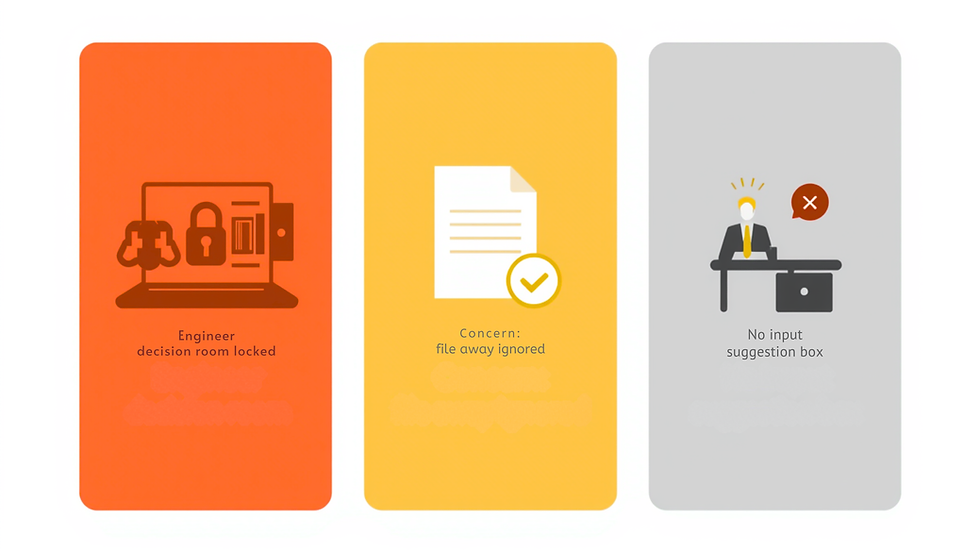
The first condition is exclusion from the selection process. When the decision about which system to adopt is made by business stakeholders, programme managers, and vendor representatives without deep involvement from the senior engineers who will implement and maintain it, those engineers receive the decision as something done to them rather than with them. In that context, their subsequent compliance is always going to be conditional.
The second condition is the dismissal of technical concerns during implementation. Even when senior engineers are given the opportunity to raise concerns after the selection decision has been made, those concerns often go nowhere. The programme is already committed to the chosen platform. The vendor contract is signed. The go-live date is fixed. In that environment, a technical concern that cannot be accommodated within the existing plan gets logged, acknowledged, and quietly set aside. The engineer who raised it watches it get set aside. They then watch the problem they predicted arrive on schedule. This sequence, concern raised, concern ignored, concern validated by events, produces the kind of bitterness that outlasts programmes.
The third condition is the absence of a legitimate influence channel. Senior engineers who trust that their concerns will be heard and acted on do not need to use illegitimate ones. The quiet sabotage pattern emerges specifically in environments where the formal channels for technical input have been closed, inadequate, or consistently ineffective. When people cannot influence outcomes through conversation, they influence them through behaviour.
What a Leader Who Understands This Does Differently

The starting point is not a conversation about the new system. It is a conversation about the old one. Before any senior engineer can become a genuine advocate for what is being introduced, they need to feel that what they built is being respected rather than discarded. That requires the programme leader to understand, specifically and in some technical detail, what the current system actually does, what engineering decisions shaped it, and what will be lost in the transition that is worth mourning. This is not a manipulation. It is the honest acknowledgment that the people who built and maintained the previous system did something real, and that the transition to a new system does not erase that value.
The second thing is to create a structured mechanism for senior technical input that has actual authority. Not an advisory group that meets and produces feedback that no one acts on. A genuine technical review function with named decision rights over specific implementation questions. The scope of that authority can be narrow, but it needs to be real. Engineers who have actual influence over implementation decisions have a personal stake in the outcome being good. Engineers who have no influence have no stake, and no stake produces no ownership.
BCG's research on technology implementation in complex organizations found that programmes that integrated senior technical staff into formal decision-making roles during implementation, rather than treating them as execution resources, were significantly more likely to deliver on time and to see sustained adoption after go-live (Boston Consulting Group, "The People Power of Transformation," 2019). The time spent on that integration is not a diversion from implementation. It is the implementation.
What to Do This Week Identify the two or three senior engineers on your programme who have gone quiet. Not the ones who are vocally resistant, not the ones who are enthusiastically on board, but the ones who were engaged earlier and are now just executing without comment. That silence is almost never contentment. Have a direct conversation, not about the programme's progress, but about what they think the programme is getting wrong. Ask specifically. Tell them you are asking because their assessment matters more to you than a comfortable meeting. Then listen without defending. You will learn something about your programme that your dashboard is not showing you, and you will shift a dynamic that, left unaddressed, is already costing you more than you realize.
Written by Transformation Leader. Published at t4leader.com.


Thank you for your thoughtful comment! I genuinely appreciate your perspective and the time you took to share it. Your support means more than you know. mutimer leather